I joined VulnCheck to write exploits.
As employee number five, more than four years ago, I wrote the first lines of code for our new product: VulnCheck Initial Access Intelligence. Initial Access, at its heart, is a dual-use product. It pairs advanced VulnCheck-developed exploits with the tools and techniques needed to detect those exploits in the wild. We believe that to write good exploit detection logic, you need a deep understanding of how the exploit works. As has often been said, good offense begets good defense. That's the heart and soul of the project.
Early in the project, long-time Metasploit hacker Will Vu joined me, and together we focused on developing exploits and detections for CVEs affecting internet-facing systems, along with developing our own exploit framework, go-exploit. We had early success after a blog about Xiongmai IoT Exploitation attracted a prospect who challenged us to find the forever-days Cisco had hinted at in an advisory with no accompanying patch. After we succeeded, we inked our first Initial Access customer.
Life was good. And busy! Will and I were seasoned exploit developers and we were providing our customers with 2-4 custom n-day exploits and detections per week! We thought we were zipping along, but it never really felt like enough. We've picked up more customers and each customer always wants more. More of what we have, but more of what we don't have. They want Nuclei. They want Sigma, WAF rules, NMAP, FOFA, version scanners, Windows CVEs, LPEs, pre-CVE details, and faster.
Always faster.
We're fortunate to do work that inspires so much interest and passion, so we expand, adapt, and grow. Over time, we added more detection artifacts. We established a service level agreement (200 per year! That felt like a heavy weight at the time). I was pulled off of full-time exploit development and into other product lines. And leadership, I suppose. But thanks to the incredible talent we somehow attracted, both our customer base and the Initial Access team grew. And grew. And grew. Today there are more than a dozen world-class full-time exploit developers at VulnCheck.
By July of 2026, the team was knocking out more than 40 exploits per month plus all their associated detection artifacts. The team had adopted Claude into workflows and were knocking out more and more difficult deliverables than ever before.
Still. It wasn't enough, because it never is.
Early in the summer, I had a conversation with VulnCheck's CEO Anthony Bettini about the future of the Initial Access team. Anthony is a technical founder who is no stranger to writing exploits himself. We shared a common concern: "What if someone leveraged AI to start producing a higher volume of exploits? How would we respond? What would that mean for Initial Access?"
We both agreed nothing was stopping a highly-skilled team from building an AI exploit development pipeline that simply churned out weaponized exploits. Then, we had no such pipeline. We had a dozen very talented hackers, but by themselves they couldn't reach the volume we envisioned. Could we be caught flat-footed in an AI-driven world while we forged ahead with humans only?
Obviously, we didn't want that to happen. So we invested resources in developing our own AI exploit development pipeline. And if we weren't concerned about quality, this would have been super easy. "Claude, write me an exploit for CVE-2026-66747. Make no mistakes. Thanks."
But we do very much care about quality. We wanted a system that produced content that matched the output of our world-class exploit developers. A system that produced all the associated detection artifacts the team developed. The version scanners. The ASM queries. The PCAPs and network rules. All of it. The exploit pipeline needed to be like any other developer on the Initial Access team: CVE in, pull request out.
Consistency and quality don't typically come out of the box. Up until now, every VulnCheck exploit had been handcrafted by an exploit developer with years of experience. Developing good, production-ready, usable exploits and detections is far, far more difficult than simply asking for them.
So that took time to get right. Honestly, it's still taking time to get right. But along the way, we've gone from 22 exploits in a month (January) to 58 exploits in a week. Then 104 exploits in a week. Then 152 exploits in a week. Then 203. 266. Each week brings improvements and higher throughput. In October, we produced more exploits than we did in the rest of the year combined. In November, we doubled October's output. It's November 23rd when I wrote this, still a week to go.
The following graph shows the total number of exploits delivered to VulnCheck Initial Access Intelligence customers each week since 2022. Before our AI pipeline, every exploit represented work done by our researchers, from vulnerability research and analysis through exploit development, testing, and the creation of associated artifacts.
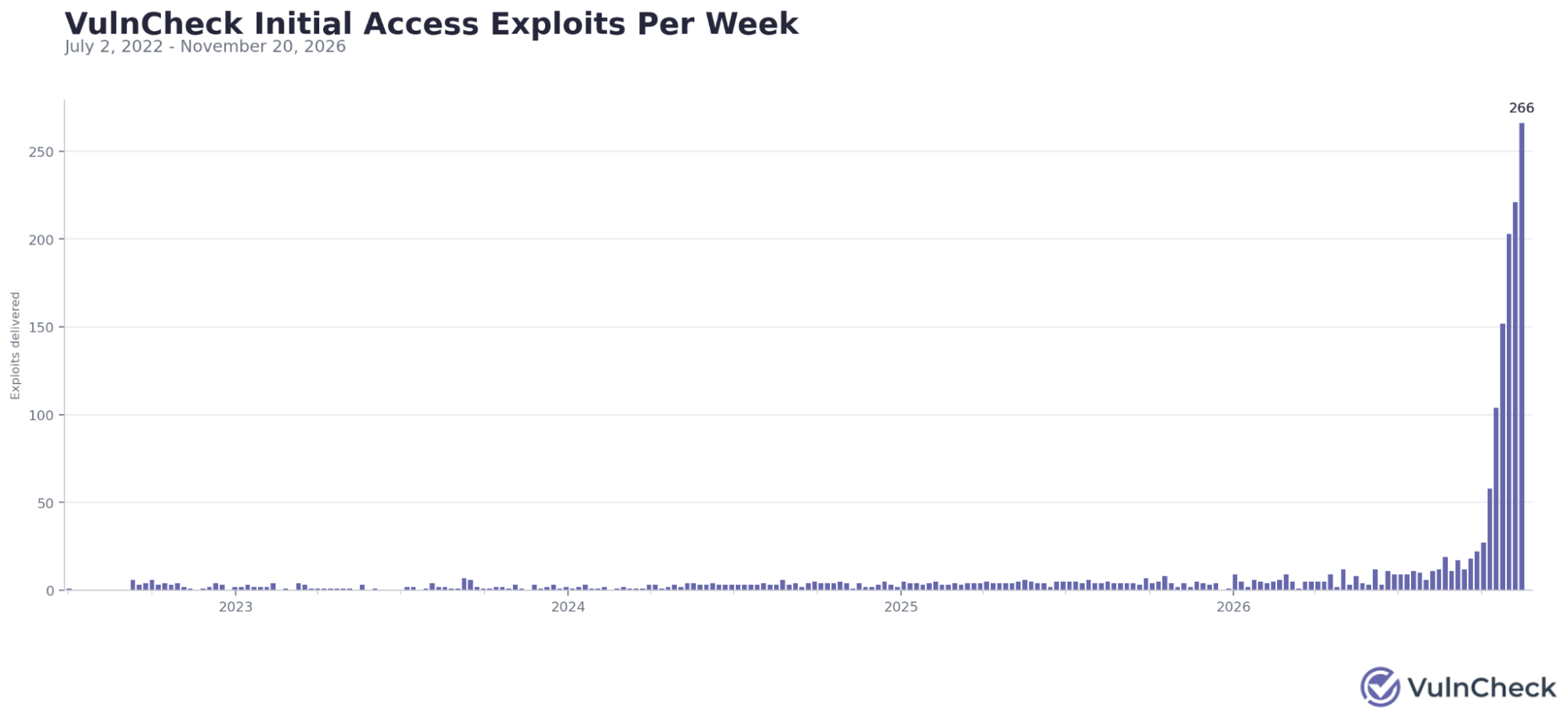
Can that go on? Likely not. We currently have a human bottleneck, and that's intentional. We still insist that humans validate and test every AI-generated pull request before we ship it to customers or use it in our own internal processes. We aren't interested in flooding the world with plausible-looking exploits or code that works only in theory. We want production-ready exploits and all their associated detection artifacts, validated by people who understand what they're looking at.
While the industry goes through a CVE boom, it hasn't seemed to be going through an exploit boom (until now).
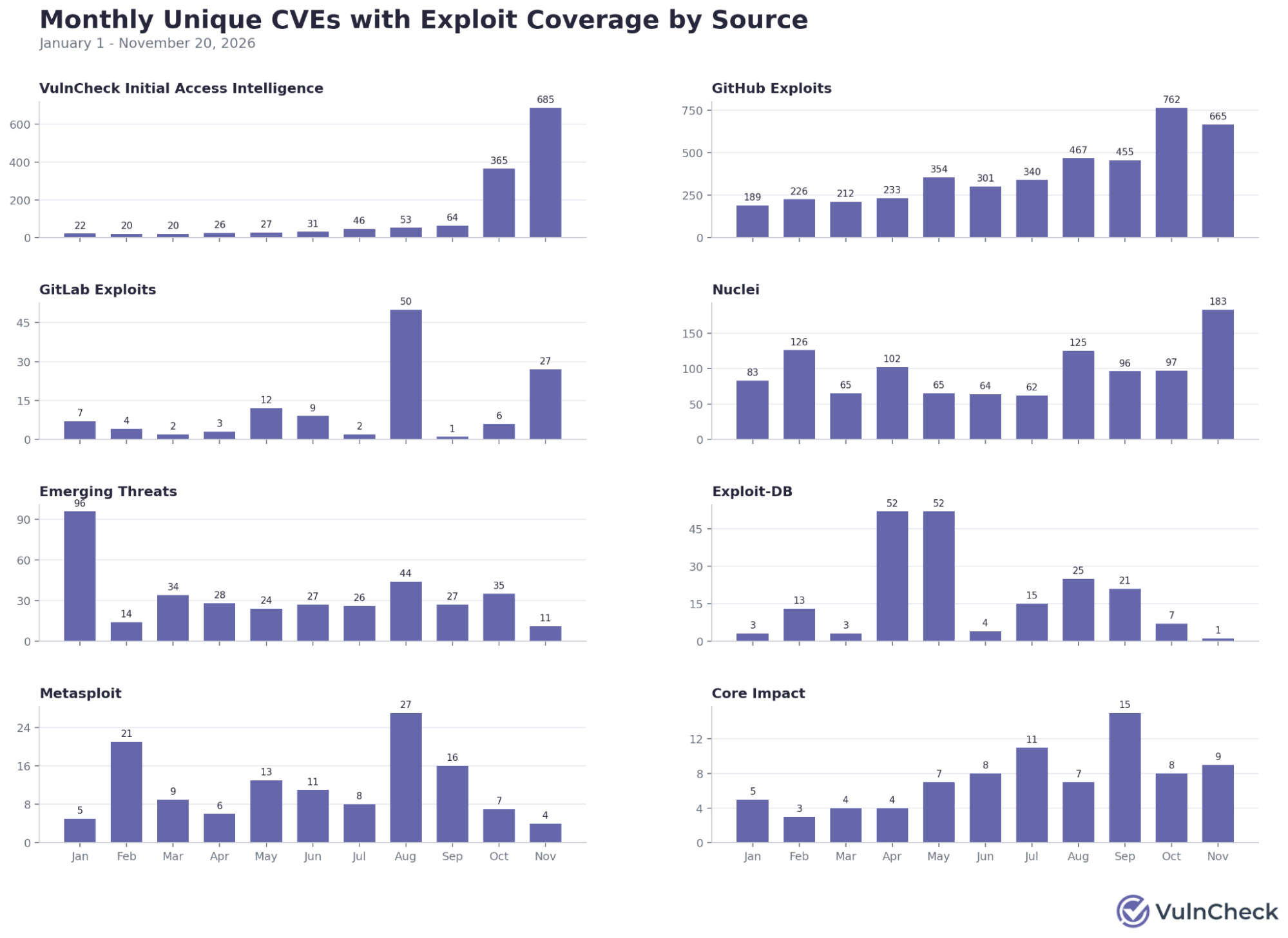
But volume doesn't tell the full story. It could be that we're just churning through SourceCodester bugs and patting ourselves on the back. That isn't what we are doing, though.
One way we validate we're developing the right exploits is by cross-referencing against what attackers are actually targeting. VulnCheck operates a network of intentionally vulnerable systems, which we call our Canary network and sell as Canary Intelligence. We deploy the vulnerable systems our exploit developers create and expose them to the internet. We also deploy the Suricata rules they write, allowing us to identify attacks targeting specific CVEs. In October and November alone, the additional coverage from our team helped us observe more than 220 CVEs we had never seen in the network before.
The impact of that expanded coverage is visible in the number of previously unseen CVEs we're observing each month.
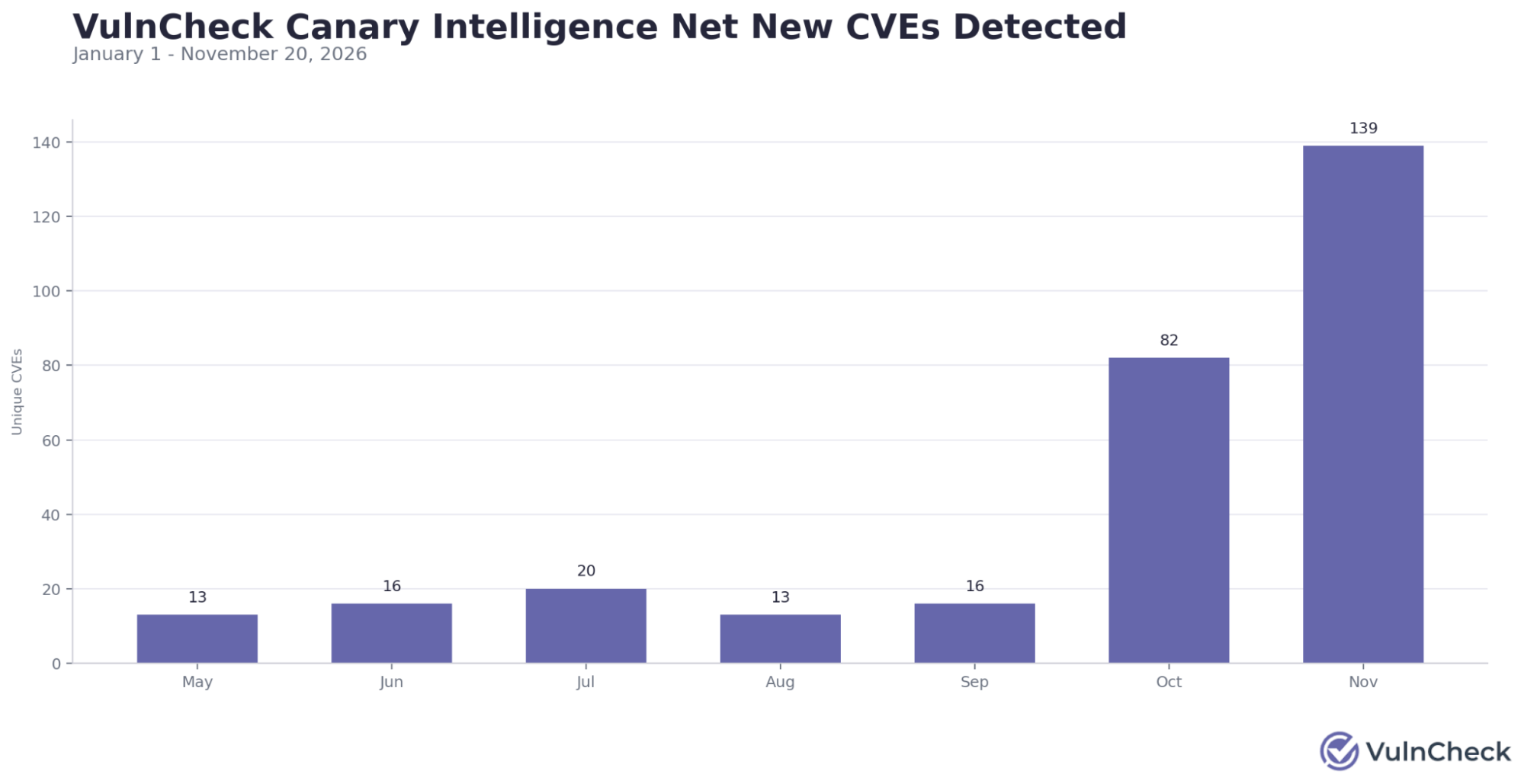
Before the AI pipeline came online, we were typically observing 13 to 20 previously unseen CVEs in the network per month. As the AI exploit pipeline came online, that jumped to 82 in October and now 139 in November. That's roughly a 5x increase in the first period and nearly 9x in the next.
Perhaps even more valuable is what we're seeing in a metric we call "First to KEV." This measures when our Canary network is the first to observe a specific CVE being exploited in the wild. That's a big deal. It means we're identifying exploitation before that activity is otherwise captured in the data that eventually makes its way into CISA's Known Exploited Vulnerabilities (KEV) catalog. This is valuable proprietary intelligence for VulnCheck and, more importantly, for our subscription customers.
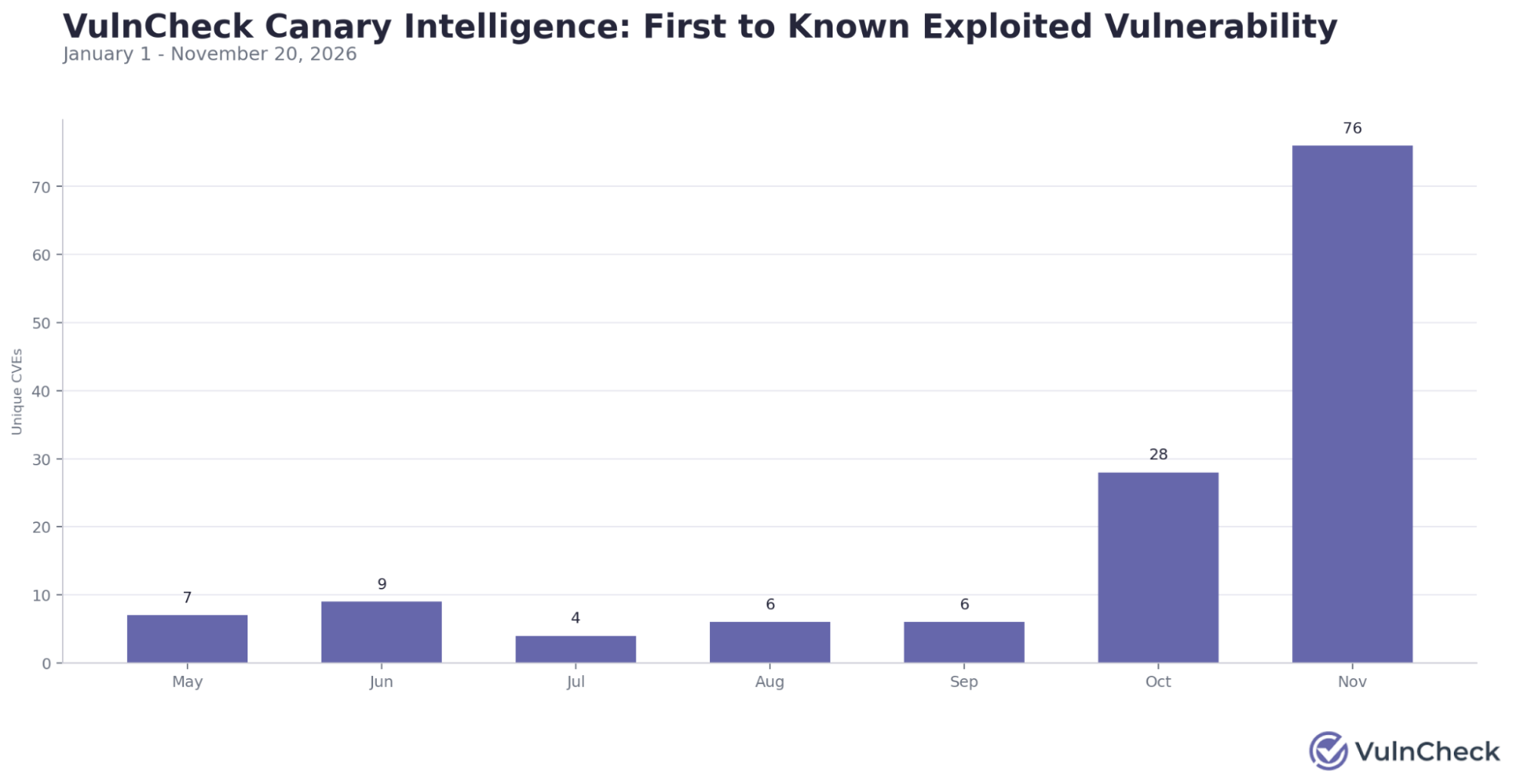
The increase we're seeing in First to KEV is directly related to the expanded coverage made possible by our AI exploit pipeline. We're developing exploits and detection artifacts for more vulnerabilities and deploying that coverage faster. That means more opportunities to observe exploitation early, and more opportunities to be first. These numbers are further confirmation that we're not just producing more exploits. We're producing coverage for vulnerabilities that attackers are actually exploiting.
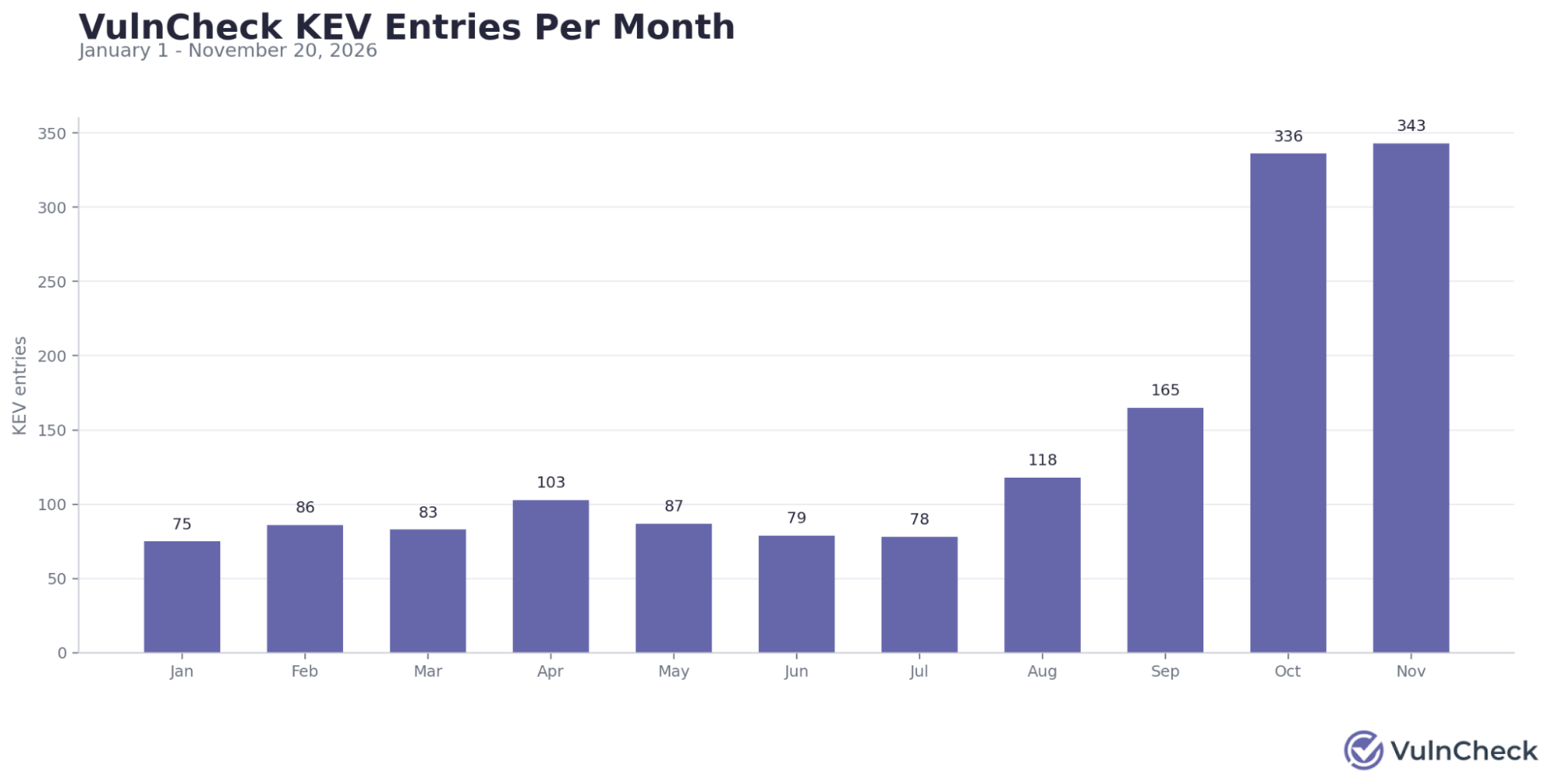
We're also seeing this reflected in VulnCheck KEV, which is freely available to everyone. As our coverage has expanded, so has the number of vulnerabilities we're identifying as exploited in the wild. Through July, we were averaging around 84 new KEV entries per month. In October, that jumped to 336. November is already 343, and we still have more than a week left in the month. This isn't just benefiting our customers. Anyone can use VulnCheck KEV, and everyone benefits from having better, more comprehensive intelligence about what's being exploited in the wild.
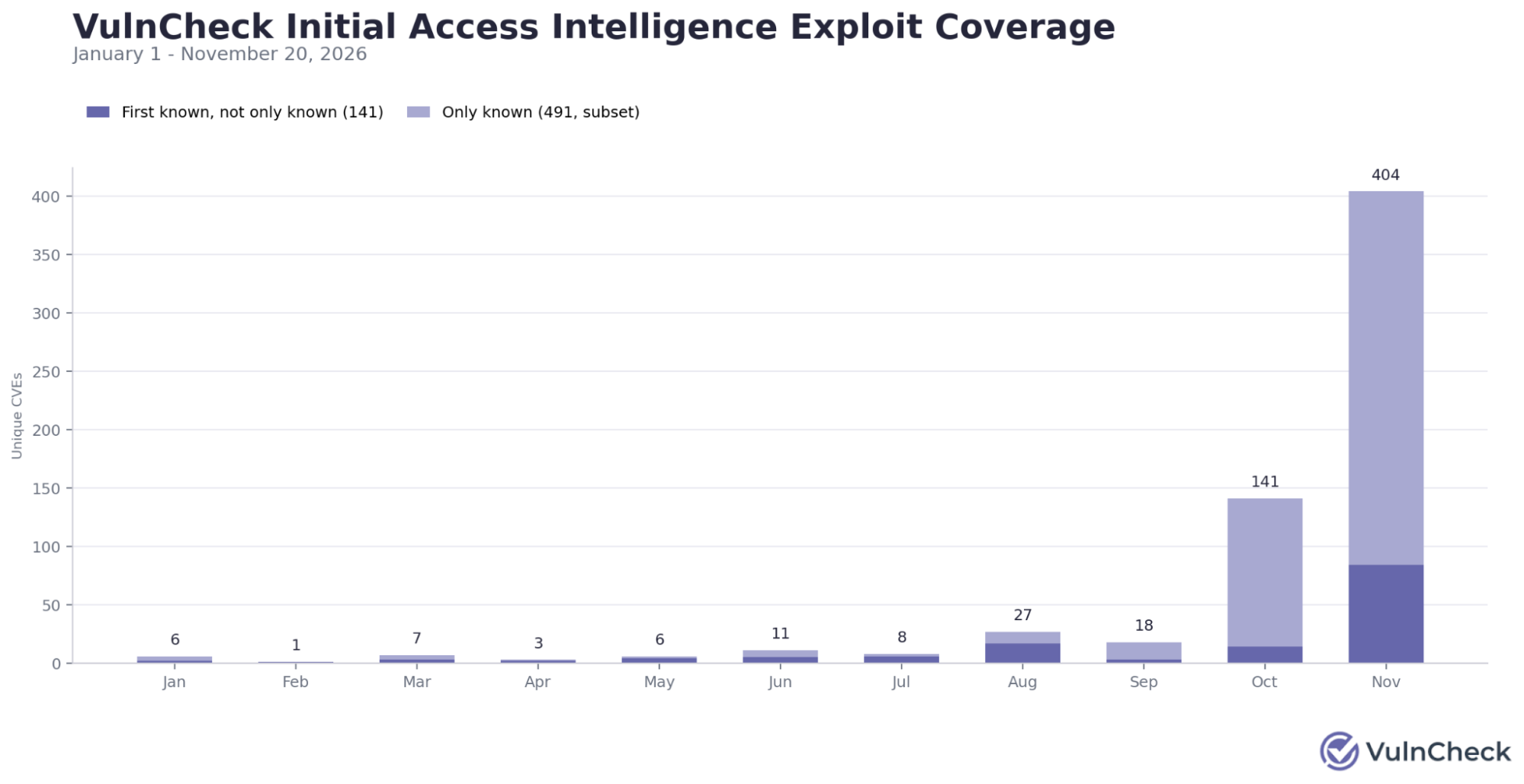
The increased coverage is also showing up in our publishing metrics. We're increasingly the first to publish a known exploit for a vulnerability, and we're producing exploits that, to our knowledge, nobody else has. Our AI pipeline is allowing us to cover more vulnerabilities faster, which translates directly into more first-to-market and unique exploit coverage.
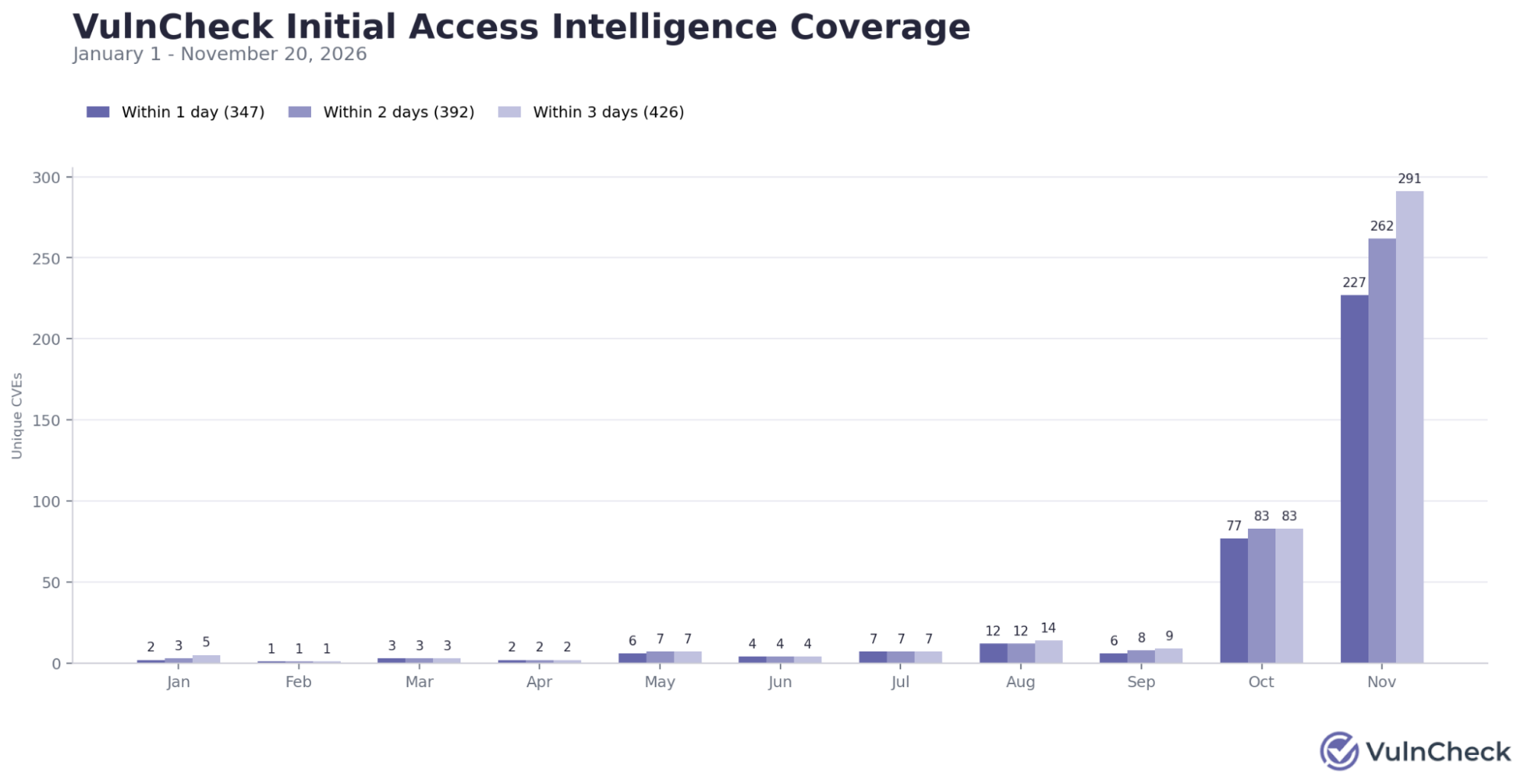
We're also getting coverage out faster. We're increasingly landing deliveries within one to three days of CVE publication, and in many cases right around publication itself. That means we're not just catching up with the vulnerability backlog. We're getting useful exploit coverage into our customers' hands while these vulnerabilities are still new.
Our AI exploit pipeline isn't just landing a boatload of exploits quickly; it's also freeing up our talented human exploit developers to do more complicated work. The team is free to tackle more complicated vulnerabilities.
Just this week, they landed remote code execution exploits against Check Point (CVE-2026-85103), Cisco NX-OS (CVE-2026-76465), and Microsoft Remote Desktop Client (CVE-2026-32157). These are exactly the kinds of projects that were difficult to justify when the team was constantly working to meet delivery commitments. We track exploit publications across the security industry, from commercial platforms like Core Impact to repositories like GitHub and Gitee, exploit databases, and independent research. To our knowledge, we're the only ones with RCE exploits for these vulnerabilities.
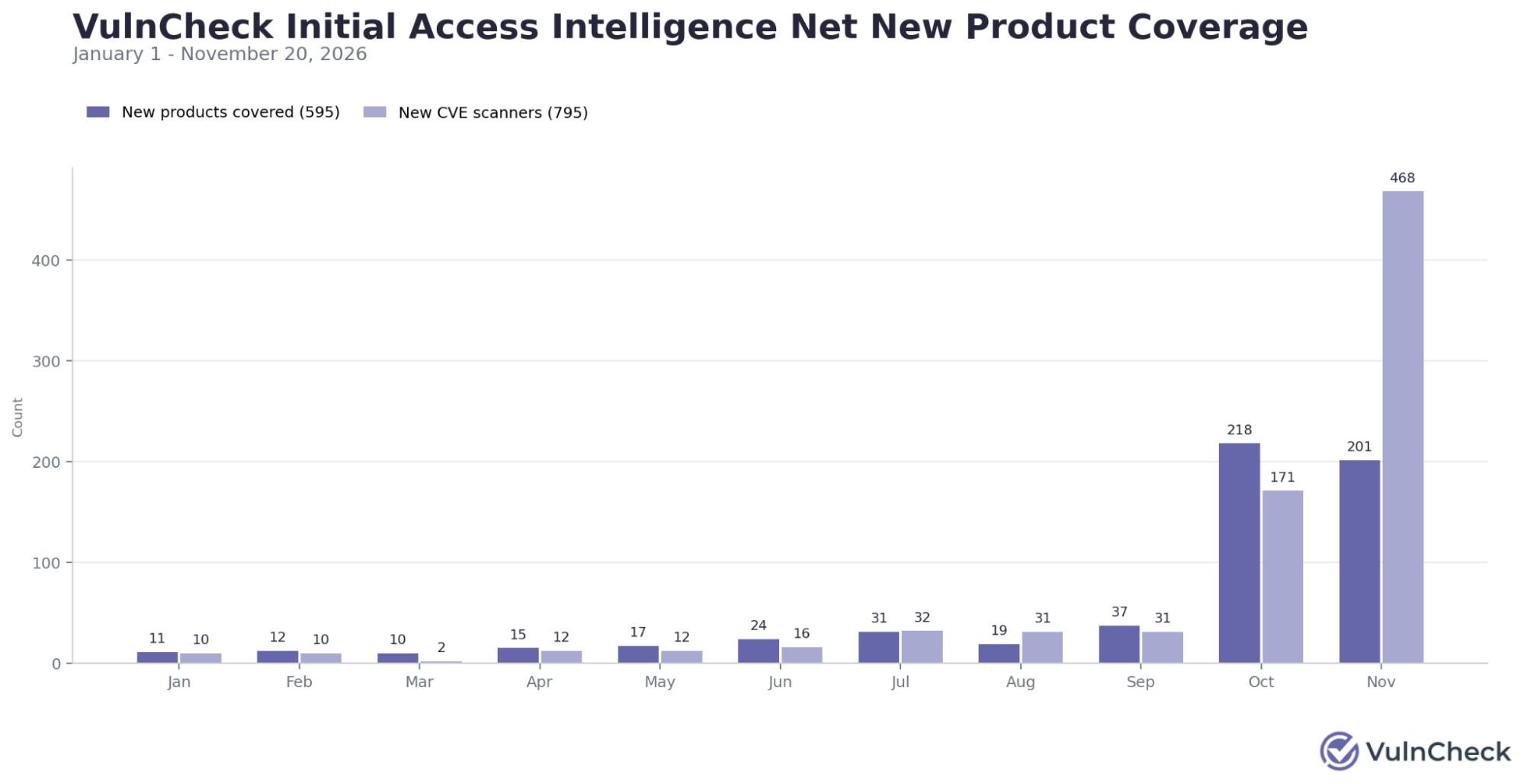
The other way we use Initial Access Intelligence internally is within our Target Intelligence product. We take the product and version scanners our exploit developers write and use them in our internet-scanning activities. Part of what makes Target Intelligence special is its ability to extract reported versions from a wider range of products than anyone else. The AI pipeline has accelerated that even further. More exploits mean more scanners, more products covered, and richer Target Intelligence data. Since the pipeline came online, we've added 595 new products and 795 new CVE scanners. That's a substantial expansion of the data we're able to provide to customers. Just like our Canary Intelligence network, we're taking the work produced by Initial Access Intelligence team and using it to make another VulnCheck product better.
We started building this pipeline because we knew the world had changed. The economics of exploit development are changing, and they're going to keep changing. But something else has changed, too. For years, our biggest constraint was the number of exploits our researchers could reasonably develop, test, and deliver. Today, that's no longer the same constraint. We're producing more exploits in a week than we once produced in months, and our researchers are spending more time on the difficult problems that originally brought them to VulnCheck.
I still love writing exploits. It's why I joined VulnCheck. But I'm pretty excited about what happens when a team of talented exploit developers isn't spending all of its time writing exploits.
We haven't run out of vulnerabilities to understand, exploits to develop, or attackers to track. If anything, we've barely scratched the surface. AI gives us the opportunity to do considerably more of that work, and I think we're just getting started. If you're curious about the kind of work we're producing, take a look at our free Initial Access Community repository, where we publish weekly releases of exploits and their associated artifacts for anyone to inspect and use.