This week, we traveled to Tokyo, Japan, to present at the Machina Cyber Intelligence Summit. For the talk, we dug into our VulnCheck Canary detections to see what regional exploitation activity looks like across the Canaries we host in Japan.
Key Findings
- From 2026-08-01 through 2026-11-02, we observed exploitation attempts against 330 CVEs from 347 unique source IPs across 46 countries.
- Network edge devices and open source software lead the targeted categories, with 66 CVEs each.
- Pakistan is the top source by unique IP, but the pattern looks like a compromised router botnet, not a campaign aimed at Japan.
- Japan's larger role in our data is as a launch platform: compromised Japanese cloud hosts are used to attack targets elsewhere, including the RedTail crypto-mining campaign and AI framework exploitation.
- Only two of the 330 CVEs appear to be Japan-specific, and both look opportunistic.
Exploitation Flows Across Japan
For this research, we evaluated VulnCheck Canary data deployed globally to understand exploitation flows both targeting and originating from Japan. Inbound activity (attacks against Canaries in Japan) is our primary lens. We also looked at outbound activity (attacks originating from Japanese IP addresses) for context, and it turned out to matter.
It's important to note that attack activity often comes from compromised infrastructure, so you shouldn't assume the exploitation is operated by someone within the country itself. The outbound evidence largely pointed to compromised cloud infrastructure, which is why most of this post focuses on what is targeting Japan.

From 2026-08-01 through 2026-11-02, we observed exploitation attempts against 330 CVEs from 347 unique source IPs across 46 countries. Source countries reflect where an IP is located, not necessarily where the operator is.
Categories and Technologies Targeted in Japan
We're particularly interested in understanding which technologies and technology categories we saw targeted in Japan, because this can give defenders useful insight into where to prioritize hardening systems, improving patch and fix management, and reducing external attack surface. It's also worth noting that VulnCheck Canaries focus on initial access exploitation, specifically vulnerabilities that are often left exposed to the internet and used by attackers to gain initial access.
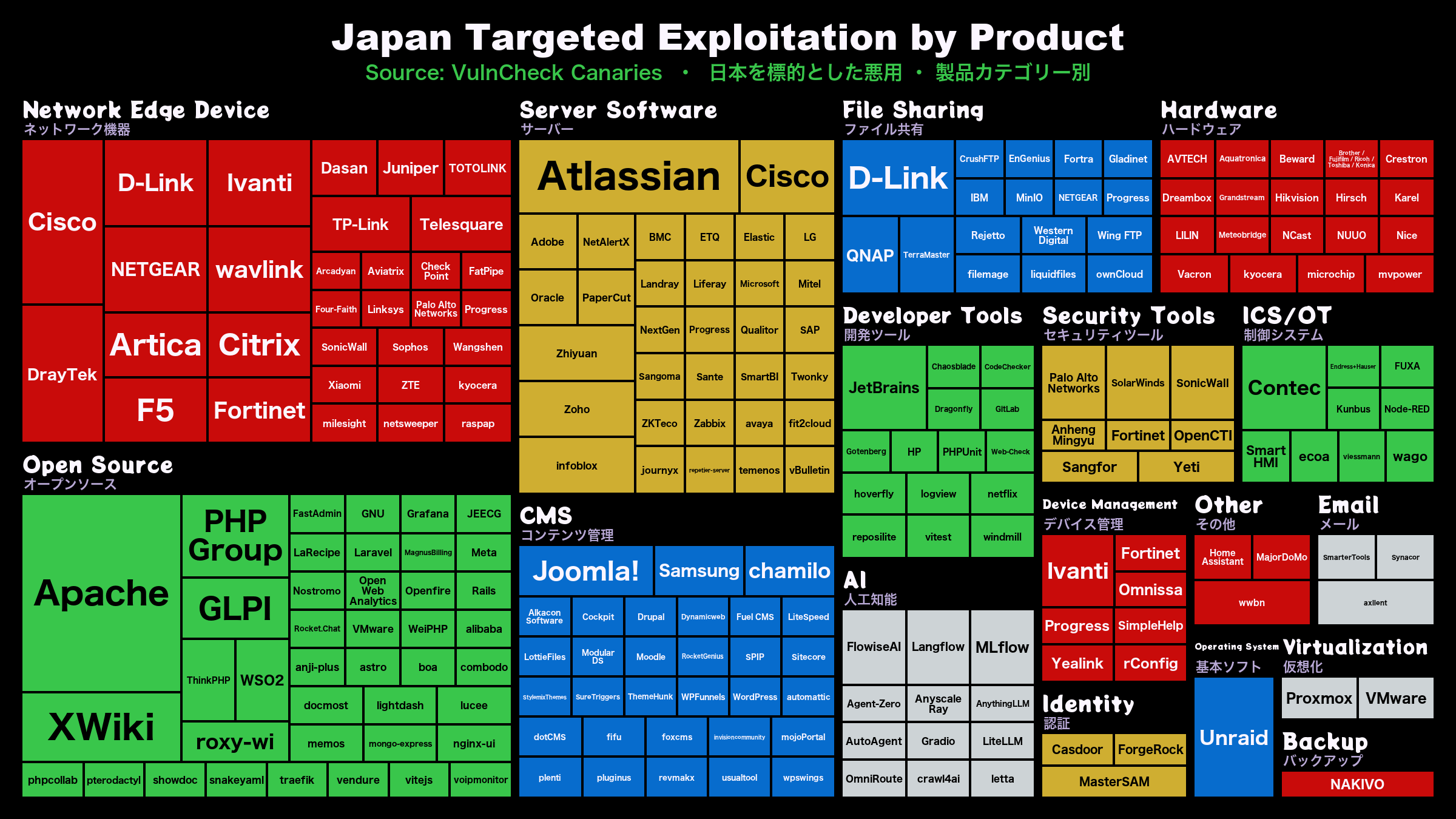
Five categories top the list for exploitation we observed targeting Japan:
- Network Edge Devices: add a stat or example here instead of restating the category name.
- Open Source Software: Apache alone accounts for 14 of these, spread across 10 different projects.
- Server Software: commonly used by enterprise organizations.
- Content Management Systems: a significant share of these are WordPress plugins.
- File Sharing: nearly half are NAS devices from D-Link, QNAP, TerraMaster, Western Digital, and NETGEAR. FTP is also a common target.
The Hardware category was a long tail of 19 vendors with a single CVE each, mostly camera systems, DVRs, and NVRs, along with printers, door access systems, and IP phones. We've often seen these types of technologies targeted by both nation-state actors and botnets.
AI tooling also made a notable showing, with 15 CVEs across 12 vendors, including Flowise, Langflow, and MLflow.
The vendors with the most exploited CVEs targeting Japan were:
- Apache (14): spread across HTTP Server, Solr, Struts, Tomcat, OFBiz, and others.
- Cisco (9): several product lines, including RV Series routers, Smart Licensing Utility, and IOS XE.
- D-Link (8): half of these are DNS-320 NAS devices.
- Atlassian (7): six of these are Confluence.
- Ivanti (6): Connect Secure, Cloud Services Appliance, Endpoint Manager, and others.
Age of Vulnerabilities Being Exploited
Threat actors are often perceived as targeting only the newest vulnerabilities, but that isn't the case. We broke down the exploitation activity we saw from 2026-08-01 through 2026-11-02 by the age of the vulnerability, measured from CVE publication date to the date of the exploitation attempt.
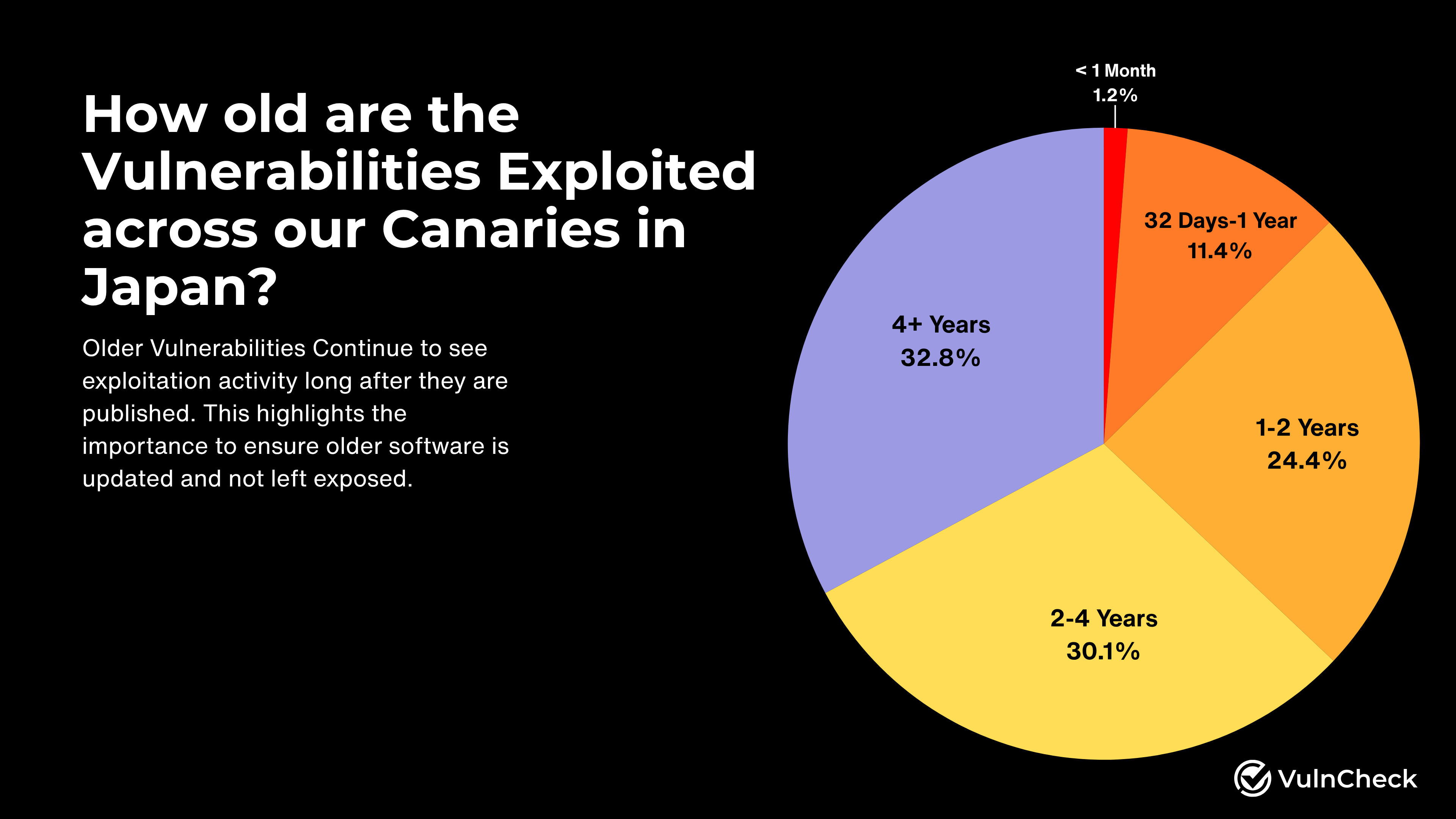
This shows how long exploitation activity persists, and why vulnerability debt and exposure deserve serious attention, not only from emerging threats but also from the older vulnerabilities and software that linger in enterprise environments.
Pakistan Stands Out as a Top Source for Exploitation Activity, but Why?
We were surprised to see Pakistan listed as the number one source by unique IP for exploitation activity, so we decided to dig into these attacks.
Pakistan ranks #1 by distinct source IPs (81) targeting Japan, yet generated only 149 hits, just 1.84 hits per IP, the broadest-but-shallowest footprint of any source country. The signature points to a compromised customer premises equipment (CPE) botnet, made up of SOHO and IoT routers, rather than a deliberate operator:
- 46 of the 81 IPs belong to a single consumer broadband provider, Cyber Internet Services (Cyber.net). The remainder are in CMPak/Mobilink and Connect Communications, all Pakistani home and mobile ISPs.
- The CVEs they fire are router and IoT recruitment exploits: CVE-2024-12847 (38 IPs), CVE-2018-10561 and CVE-2018-10562 in GPON routers (28 IPs each), and CVE-2016-20016 in MVPower DVRs. These are classic Mozi-style botnet vectors used to enroll new devices.
This pattern is an artifact of infected Pakistani home routers spraying a handful of router and IoT CVEs. It's typical botnet activity, likely not a campaign directed solely at Japan.
Three Attack Patterns
Across all exploitation observed against Japan, activity resolves into three distinct patterns.
| # | Pattern | Signature | Intent |
|---|---|---|---|
| 1 | Distributed botnet (fixed exploit pack) | libredtail-http with C2 | Crypto-mining |
| 2 | Vulnerability validation | Confirming vulnerable targets | Discovery |
| 3 | Credential harvesting | .aws/credentials, IMDS SSRF, .env sweeps | Credential theft |
Pattern 1, RedTail crypto-miner, is the largest campaign in the Japan data, and it appears in both directions. It uses the libredtail-http user agent and pulls redtail.sh, setup_moneroocean_miner.sh, and xmrig from a tight Contabo (Germany) command-and-control (C2) block. Japanese cloud hosts are enrolled as launch nodes, which is the core "Japan as a launch platform" finding. Add a hit count or share of total activity.
Pattern 2, vulnerability validation, scans hosts to confirm which are vulnerable before weaponizing.
Pattern 3, credential harvesting, is the highest-intent pattern: direct attempts to steal cloud instance credentials via instance metadata service (IMDS) SSRF (169.254.169.254) and to read secret files (.aws/credentials, .env, .git/config, SSH keys).
AI Technologies
AI/ML framework exploitation is largely outbound, launched from Japanese cloud infrastructure toward targets outside the country, which is consistent with the RedTail pattern. These don't appear to be AI-powered attacks. They are conventional exploits against AI infrastructure.
| Product | Top CVE | Unique IPs | Notable |
|---|---|---|---|
| Gradio | CVE-2026-28414 | 53 | #1 AI CVE; callbacks to C2 |
| Langflow | CVE-2025-3248 | 30 | 210 hits; recon and Sliver C2 |
| Flowise | CVE-2025-8943 | 11 | 218 hits; recon callbacks |
| Langflow | CVE-2026-0768 | 10 | S3-hosted payloads |
| Ray, LiteLLM, Dify, MLflow, AnythingLLM | Various | 1-5 each | Long tail |
Inbound AI targeting of Japan 1-3 hits per CVE. That fits with the 15 AI CVEs mentioned earlier: many CVEs, but little inbound volume. AI frameworks are being exploited from Japanese cloud far more often than they are attacked in Japan, which reinforces that Japan's role in this data is primarily that of a compromised launch platform.
Japan's Important Role in Reporting Exploitation Evidence
This research highlights the importance of regional CERTs and Japanese organizations in reporting exploitation. JPCERT/CC and IPA jointly operate Japan Vulnerability Notes (JVN), which coordinates with vendors to disclose vulnerabilities. In 2026, five vulnerabilities in VulnCheck Known Exploited Vulnerabilities (KEV) were first reported by a Japanese (.jp) source: four on JVN and one in a vendor advisory. Three of the five were later added to CISA KEV: two of them 6–11 days after they were added to VulnCheck KEV, and one on the same day. The other two are referenced only by JVN and are not on CISA KEV.
| CVE | Vendor | Product | VulnCheck KEV | Reference | On CISA KEV |
|---|---|---|---|---|---|
| CVE-2026-103671 | EC-CUBE CO.,LTD. | AmazonPay V2 Plugin | 2026-10-14 | JVN#43511918 | — |
| CVE-2026-106931 | EG Secure Solutions | SiteGuard Server Edition | 2026-10-14 | EG Secure advisory | 2026-10-20 |
| CVE-2026-34926 | Trend Micro | Apex One | 2026-05-21 | JVNVU#90583059 | 2026-05-21 |
| CVE-2026-32661 | Canon Marketing Japan Inc. | GUARDIANWALL MailSuite | 2026-05-13 | JVN#35567473 | — |
| CVE-2026-25108 | Soliton Systems K.K | FileZen | 2026-02-13 | JVN#84622767 | 2026-02-24 |
This led us to another question: is there any exploitation evidence across our Canaries that is unique to Japan?
Of the 330 CVEs observed targeting Japan-based sensors, only two appear to be Japan-specific. This doesn't rule out regional targeting of specific vulnerabilities, but it shows that the vulnerabilities exploited in our Japan canaries are almost always exploited elsewhere too. The two we looked at appeared to be more opportunistic than targeted.
What Defenders Should Take From This
- Prioritize patching and reducing exposure for network edge devices, CMS, Server Software, open source software, and file sharing tools, the five largest categories we saw targeted.
- Don't treat old vulnerabilities as unlikely targets.
- Audit and retire exposed SOHO, IoT, and camera hardware. These devices are both targets and recruits for botnets.
- Lock down cloud instance metadata (for example, by enforcing IMDSv2) and keep secrets such as
.envand.aws/credentialsfiles out of web-accessible paths. - Patch internet-facing AI frameworks like Gradio, Langflow, and Flowise, and keep them off the public internet where possible.
- Monitor broad sources for exploitation evidence using VulnCheck KEV to ensure you capture regional reported exploitation.
Methodology and Data Caveats
VulnCheck Canaries are real vulnerable hosts, deployed worldwide, that capture real exploit attempts, including the delivered payload, source, and targeted CVE. We extracted two slices of this telemetry:
- Inbound: records where the destination (sensor) country is Japan (
dst_country=JP). - Outbound: records where the source country is Japan (
src_country=JP).
All figures in this report are restricted to a common window of 2026-08-01 through 2026-11-02.
A few caveats apply:
- This research focuses only on what we see across our Canaries, which is a fraction of all vulnerabilities reported as exploited in the wild. For a more complete picture, we suggest reading our 1H 2026 State of Exploitation report.
- This report was limited in time so it's likely there is a lot more we can dive into in the future as there is a goldmine of payload data to dig into, this largely was looking at top level trends we observed. Something I'd like to circle back to when we have some more time.
About VulnCheck
VulnCheck is helping organizations not just to solve the vulnerability prioritization challenge - we’re working to help equip any product manager, CSIRT/PSIRT or SecOps team and Threat Hunting team to get faster and more accurate with infinite efficiency using VulnCheck solutions.
We knew that we needed better data, faster across the board, in our industry. So that’s what we deliver to the market. We’re going to continue to deliver key insights on vulnerability management, exploitation and major trends we can extrapolate from our dataset to continuously support practitioners.
Are you interested in learning more? If so, VulnCheck's Exploit & Vulnerability Intelligence has broad threat actor coverage. Register and demo our data today.